

Photocatalytic Oxidation (PCO)
Photocatalysis is the science of using light to drive a chemical reaction on the surface of a catalyst. Its modern story began in 1972, when Japanese scientists Akira Fujishima and Kenichi Honda showed that titanium dioxide (TiO2) under ultraviolet light can split water. Since then, TiO2 photocatalysis has become one of the most studied ways to clean air and water, and is used today on self-cleaning glass, hospital surfaces and in clean rooms.
How it works
- Light activates the catalyst. When UV-A light (wavelength below about 387 nm) hits nano-sized TiO2, it lifts electrons into an excited state, leaving positively charged “holes” behind.
- Powerful oxidants are formed. These electrons and holes react with moisture and oxygen in the air to produce hydroxyl radicals (•OH) and superoxide ions (O2•−) — among the strongest natural oxidisers.
- Pollutants are broken down. Volatile organic compounds such as formaldehyde, toluene and xylene, plus odour molecules, are oxidised step by step into harmless water and carbon dioxide.
- Microbes are inactivated. The same reactive species damage the cell walls and membranes of bacteria, fungi and viruses. Laboratory studies show TiO2 photocatalysis is active against a wide range of microorganisms.
Photocatalysis inside Dr.Clean
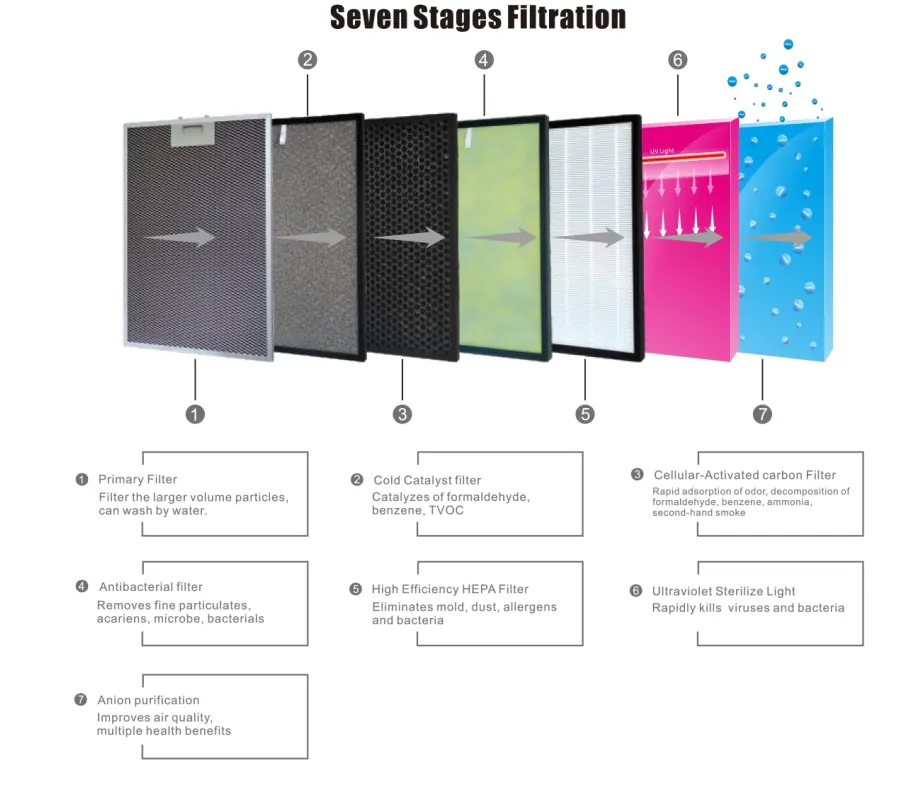
In the Dr.Clean DAP88C, a filter coated with nano-TiO2 sits behind the pre-filter, HEPA and activated-carbon layers. Two built-in 365 nm UV-A lamps shine directly onto it. Because the catalyst is not consumed by the reaction, it keeps working as long as the light is on — it does not simply fill up like a conventional filter, and pollutants are destroyed rather than stored.
Good to know: photocatalysis works best when air passes slowly and evenly over a well-lit catalyst, and some reactions pass through short-lived intermediates. That is why Dr.Clean pairs the photocatalytic filter with an activated-carbon layer and a HEPA filter: each stage covers the limits of the others.
Video: how photocatalytic oxidation breaks pollutants down (58 s)